
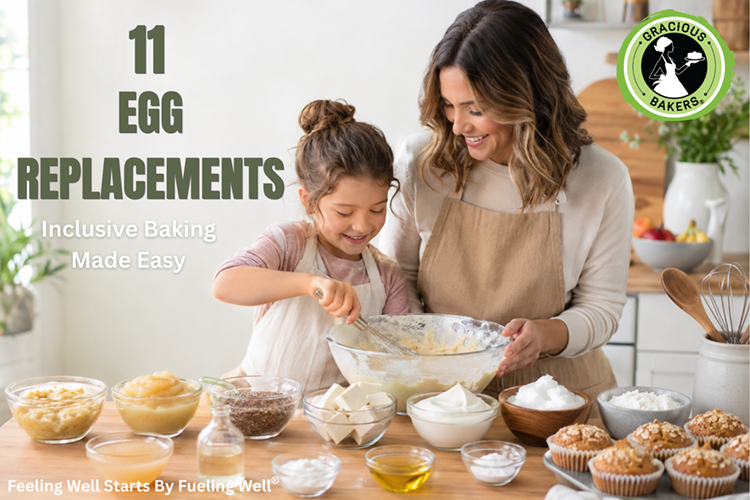
11 egg replacements for baking
We learn how to make baking easier with 11 egg replacements.
Baking is often about so much more than simply making something to eat. It’s birthday cakes, pancakes on a Saturday morning, muffins for the school lunchbox, children standing on a chair next to mom mixing a bowl, and those simple family moments we often remember for years.
But when someone in the family can’t eat eggs, whether because of an allergy, dietary requirement, plant-based lifestyle or personal preference, you may think that their favourite baking recipes are no longer possible. The good news is that an egg is always replaceable.
What I’ve learned through years of developing allergen-free recipes is that the first question shouldn’t simply be: What can I use instead of an egg? The better question is: What is the egg doing in this recipe?
Once you understand its purpose, replacing it becomes much easier.
For families navigating oncology care, cancer treatment or recovery, food can also become more complicated. Treatment can affect appetite, taste, mouth comfort, nausea. and digestion, while your loved one may already be managing an allergy or intolerance at the same time. Having reliable egg replacements creates more choices and can help families keep familiar baked foods available when eating feels more difficult.
Where egg is a known allergen or isn’t well tolerated, removing it can help prevent avoidable reactions or discomfort. It’s important, however, not to remove protein unnecessarily.
During cancer treatment and recovery, adequate protein is important for maintaining muscle, supporting immune function, and helping the body repair and heal. Eggs can still be a useful protein source for people who tolerate them, while egg-free baking provides practical alternatives for those who can’t or prefer not to eat them.
Why are eggs used in baking?
Eggs can perform several different jobs. They may help bind ingredients together, provide moisture, give a product structure, contribute richness, or help a cake or muffin become lighter and rise. This is why there is no single egg substitute that works perfectly in every recipe.
A banana may work beautifully in a muffin but wouldn’t necessarily be the best choice in a light vanilla cake. Aquafaba can provide aeration, while flaxseed is particularly useful when binding is important.
At Gracious Bakers®, we look at the function of an ingredient first and then determine which alternative can provide the result we need.
11 egg replacements for baking
1. Mashed banana
A ripe banana is probably one of the easiest egg replacements to introduce to children.
Simply mash approximately: ¼ cup mashed ripe banana = 1 egg.
Banana adds moisture and helps bind ingredients together. It works particularly well in muffins, pancakes, brownies, breads, and other recipes where a little banana flavour will not be a problem.
The riper the banana, the sweeter it becomes, so you may also find that you need slightly less added sweetness in your recipe.
It’s also a lovely job for younger children: peel, mash, measure, and mix.
2. Applesauce
Unsweetened applesauce is another easy replacement.
Use approximately: ¼ cup unsweetened applesauce = 1 egg.
Apples naturally contain pectin, which helps ingredients bind together, while the puree adds moisture.
It’s particularly useful for cakes, muffins, brownies, pancakes, and breads.
Applesauce can produce a slightly denser bake, so it’s often best suited to recipes where softness and moisture are more important than a very light, airy texture.
3. Silken tofu
This one often surprises people. Blend: ¼ cup silken tofu = 1 egg.
The tofu needs to be blended until completely smooth before adding it to your wet ingredients.
Its mild flavour means it can disappear quite easily into a recipe while helping provide moisture and structure.
It works particularly well in brownies, cakes, pancakes, and denser baked products.
For children, it’s also a wonderful example of how an ingredient can completely change once it becomes part of a recipe.
4. Ground flaxseed or chia seeds and water
This is one of my favourite little food-science experiments to do with children.
Mix: 1 tablespoon ground flaxseed or chia seeds + 2½ tablespoons water = 1 egg.
Leave it to stand for approximately 10–15 minutes.
The seeds absorb the water and develop a gel-like consistency. That gel can then help bind the ingredients in muffins, pancakes, cookies, bars, and other baked products.
Let your children look at the mixture when you first combine it and then again 15 minutes later. They can see the ingredient changing.
5. Coconut yoghurt
Use: ¼ cup coconut yoghurt = 1 egg.
Coconut yoghurt provides moisture and can bring a little acidity into the recipe, which makes it useful for cakes, cupcakes, brownies, and muffins.
Use a plain or unsweetened version so that you have better control over the sweetness and flavour of the final bake.
For families who are baking both egg-free and dairy-free, it can be a particularly useful pantry option.
6. Coconut cream
Coconut cream works slightly differently because it provides more richness and fat.
Use approximately: ¼ cup coconut cream = 1 egg.
It’s particularly useful in moist cakes, muffins, brownies, puddings, and richer baked products.
Because coconut cream has its own flavour, use it in recipes where that flavour naturally works with the other ingredients.
7. Arrowroot powder or cornstarch
Sometimes you need something very simple that primarily helps with binding and structure.
Mix: 2 tablespoons arrowroot powder or cornstarch + 3 tablespoons water = 1 egg.
Stir it until smooth before adding it to your wet ingredients.
This works well in a variety of baking applications, including cakes, cookies, muffins, and breads, and both ingredients are also useful thickeners in desserts, such as custards and puddings.
It’s an easy option to keep in the pantry because you don’t need fresh ingredients available.
8. Vinegar and baking soda
This replacement is about lift.
Mix: 1 tablespoon vinegar + 1 teaspoon baking soda = 1 egg.
When vinegar and baking soda react, carbon dioxide is released, creating small bubbles that can help make baked products lighter.
This can work particularly well in cakes, muffins, cupcakes, crumpets, and quick breads.
For children, this is another fantastic kitchen experiment. You can watch the reaction taking place.
A useful tip is to add your vinegar to the wet ingredients and baking soda to the dry ingredients and then combine everything shortly before baking so that you make good use of the reaction.
9. Oil, water, and baking powder
This is a very useful option when you don’t want to introduce a strong additional flavour such as banana or coconut.
For our baking applications we use: 1 teaspoon neutral vegetable oil + 2 teaspoons water + 1 teaspoon baking powder = 1 egg.
The water adds moisture, the oil provides some richness, and the baking powder assists with lift.
It can be useful for biscuits, brownies, cakes, and quick breads.
Use a neutral-flavoured oil unless you specifically want the flavour of the oil to be part of your recipe.
10. Aquafaba
Aquafaba sounds complicated, but it’s simply the liquid from cooked or canned chickpeas.
Use approximately: 3 tablespoons aquafaba = 1 egg.
Aquafaba can also be whipped, much like egg white, trapping air, and creating volume.
This makes it useful in products such as cakes, mousses, pancakes and meringue-style recipes.
Instead of pouring the liquid from a tin of chickpeas down the sink, put it into a clean mixing bowl and beat it.
11. Slurry
The final replacement came from my own development work at Gracious Bakers®.
Bread presents a very different challenge from a muffin or pancake because you need to consider moisture, mouldability and structure, particularly in allergen-free baking.
This slurry was developed specifically for larger bread applications.
The basic method uses: 60g Gracious Bakers Bread Flour + 170g water = 1 egg.
The flour and cold water are mixed and then cooked on the stovetop while stirring continuously until the mixture forms a ball. It’s then cooled to room temperature before being incorporated into the bread mixture.
The cooked mixture can help improve texture, moulding, moisture, and structure in larger allergen-free breads, and sourdough.
For me, this is also an important example of innovation.
Sometimes the answer isn’t finding another ingredient that looks like an egg. Sometimes the answer is understanding what the egg was doing and developing an entirely different process to achieve the same purpose.
Egg-free doesn’t mean protein-free
Nutrition during cancer treatment should always be individual. Protein remains particularly important for healing, tissue repair, immune function, and maintaining muscle, so egg-free doesn’t mean protein-free. Where eggs are removed, other suitable protein sources should be included according to the person’s needs and the advice of their oncology team or dietitian. For people with a weakened immune system, food safety is also important; raw or undercooked eggs may need to be avoided, while fully cooked or pasteurised eggs are safer when eggs are included.
A practical egg-replacement habit
Before replacing an egg, ask:
- What job is the egg doing?
- Do I need binding?
- Do I need moisture?
- Do I need lift?
- Do I need richness?
- Will the flavour of my replacement work with the recipe?
- Am I replacing one egg or several?
If a recipe relies heavily on eggs, simply exchanging every egg for the same substitute may not always give you the best result.
Sometimes combining techniques, for example, moisture from applesauce together with aeration from aquafaba, gives a much better bake.
Want to learn more?
For the complete Gracious Bakers® guide to all 11 egg replacements, including measurements, procedures, baking applications, tips, and how we use them in different Gracious Bakers recipes, read the full article here!
Disclaimer: This article is for general educational purposes only and is not a substitute for medical advice, diagnosis or treatment. Nutritional needs during cancer treatment and recovery vary from person to person. Always consult the treating oncology team, a qualified healthcare provider or registered dietitian before making significant dietary changes or removing important food groups.
MEET THE EXPERT

