
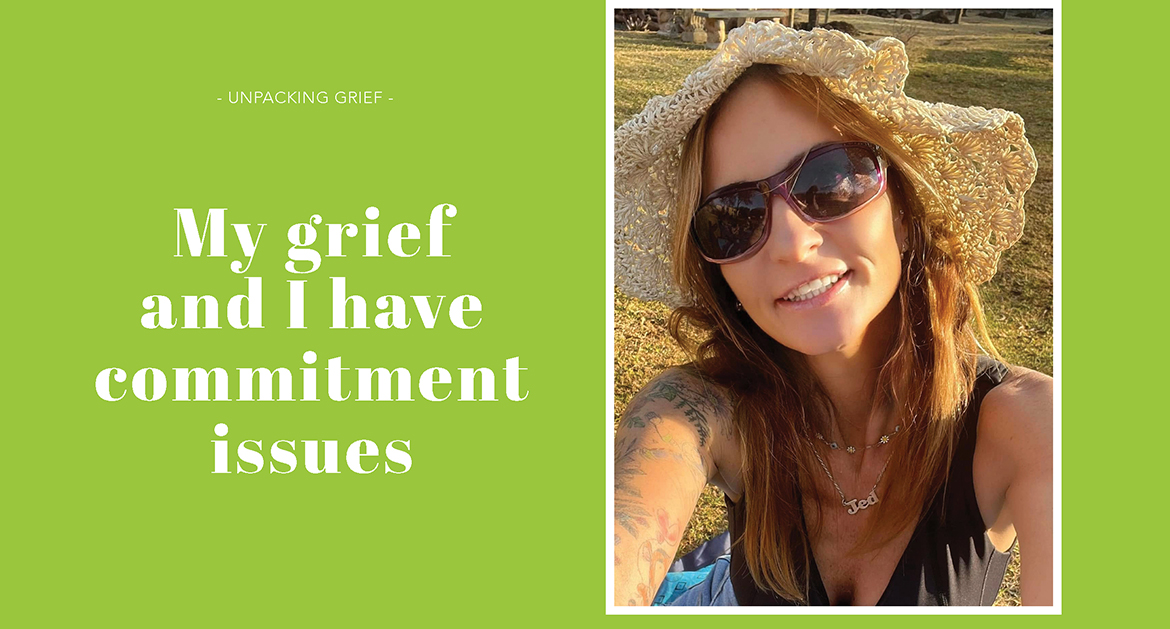
My grief and I have commitment issues
Bonni Suckling reflects on how removing a sentimental silver necklace became a quiet step forward in her ongoing journey with grief.
My grief and I have been in a long-term relationship. Fifteen years. At this point we should probably have matching tattoos and a joint savings account. But lately things have been tense between us.
The current conflict started with a silver necklace. For fifteen years, my son’s name, Jed, has rested against my chest on a little silver chain. This name pendant that has seen things: hospital corridors, triathlons, marathons, and plenty of very ordinary days. It has bounced on my chest and quietly told the world: there is a boy called Jed in my life. It has been my constant.
Years ago, when I was a bridesmaid for my little sister, I quietly asked her if I should take off my necklace. I knew the wedding party was meant to look the same. She took my hand, looked right at me, and said softly, “You have the most beautiful necklace, please wear it.” I have never forgotten that.
My fingers know exactly where to find Jed’s name without looking. Like checking for your phone. Without meaning to, I turned it into my own small fidget spinner.
Except recently…the necklace started annoying me. Not emotionally. Physically.
After fifteen years of loyal service, the links are worn, and the metal has started picking fights with my skin. Sharp little jabs from broken links. Continuously.
I’m not built for pokey things. I remove clothing labels and perform emergency wardrobe surgery for an annoying tag.
So, this necklace situation became complicated. At first, I did what any reasonable grieving mother would do.
I ignored it. Because obviously the correct response to being repeatedly stabbed in the collarbone by your child’s memorial jewellery is to suffer quietly and carry on. Emotional logic.
But the necklace was persistent. Poke. Poke. Poke. Scratch. Scratch. Scratch.
Naked, exposed, and full of guilt
And so…one night, very quietly, very reluctantly…I took it off. I felt exposed and naked. Vulnerable. Empty. I sat on my cold bedroom floor, crying for a long time afterwards. Bubble snot moment.
Friends…the guilt. The moment that necklace left my neck, my grief sat bolt upright and said, Oh. So, this is what we’re doing now? Moving on, forgetting.
Suddenly my brain was hosting a full irrational meeting, voices, loud and internal.
How can you take off his name? What kind of mother does that? You are over it, at least people will “think” you are. Confirmation, you have moved on.
Grief doesn’t believe in reasonable explanations. It doesn’t care about worn metal links or sensory issues. It would very much prefer you always remain visibly heartbroken, just to be safe.
But here is the honest part. Alongside the guilt, was relief. Not emotional relief. Physical relief. My neck was suddenly naked and, quite frankly, living its best shamelessly poke-free life. I have more freckles than I remember on my chest.
It turns out you can love your child with your whole shattered heart and enjoy not being repeatedly stabbed by jewellery. Who knew?
The small shifts
If you are reading this while carrying your own loss (your husband, wife, child), you may recognise this strange terrain. Not the necklace specifically. But the moment when something small shifts. When you pack away the hospital file. When you move their shoes. When you move your dad’s floating trophies (the ones he bragged about your whole life) to the garage. Their precious things.
Then you must sit down afterwards because your hands won’t stop shaking. Parts of your person leaving the nest. Memories in files, shoes, trophies, necklaces. It feels disloyal. As if grief is standing in the corner with its arms folded.
For a long time, I believed my grief required visible proof. Proof I was still Jed’s mother. Proof that my love hadn’t softened with time. The necklace became part of that proof.
Taking it off, even for the most practical and slightly stabby of reasons, felt loaded with meaning my rational brain knew wasn’t entirely fair.
Love doesn’t live in their things
What I’m learning, very slowly and gently is this: love doesn’t live in the metal. Jed isn’t more present when the necklace is on. He isn’t less loved when it’s off. He lives in the permanent rewiring of my heart, in the way I still notice the small-boy energy in hospital wards, and in my work that grew from the crater his life left behind.
If you’ve ever felt guilty for a small step forward. If you’ve ever removed the necklace, packed away their toys, or given away the clothes of someone you love more than oxygen, please hear this from someone who has sat in that exact tender space: Your love isn’t measured by what you wear or what you keep. Your healing isn’t a betrayal. Your person isn’t kept alive by your suffering. Maybe, your ache has softened into something tidy or inspirational. Present but neat.
Loving our people changes the architecture of our hearts but our commitment to them remains beautifully stubborn.
MEET THE EXPERT

Bonni Suckling is the founder of Rainbows and Smiles Foundation. In 2022, she completed her Paediatric Post Grad Diploma, a testament to her dedication to improving paediatric healthcare. She has played a pivotal role in establishing paediatric palliative care support groups, offering solace and guidance to families. She is also a gym instructor and endurance athlete.

Header image by Freepik