
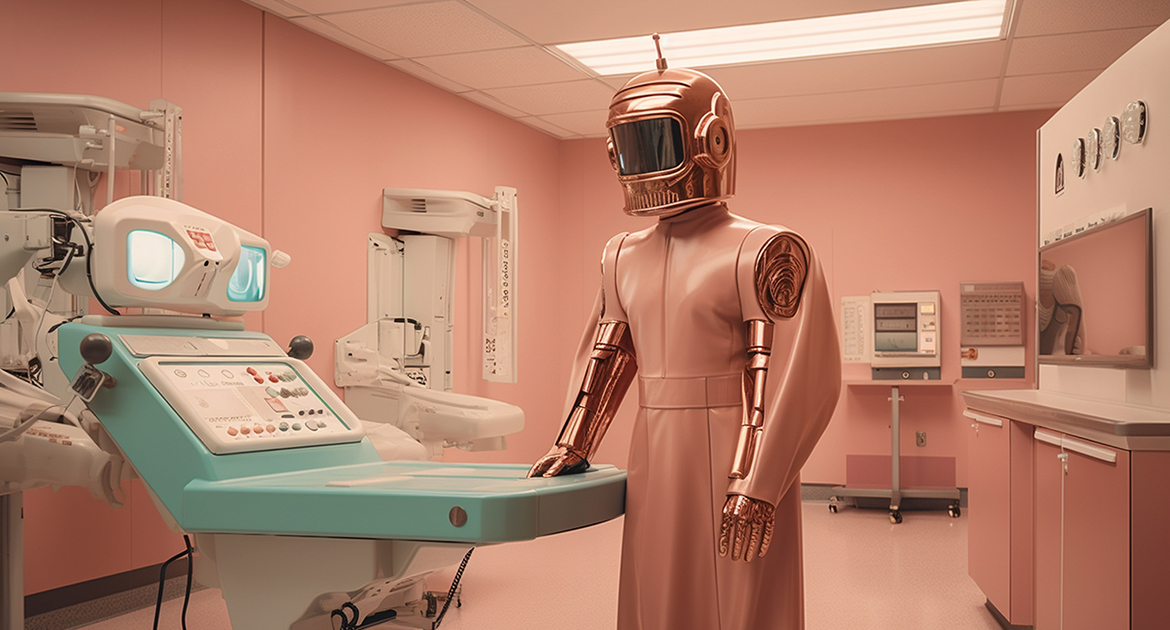
AI in cancer care: helpful assistant or hidden risk?
Dr Memory Bvochora-Nsingo reflects on artificial intelligence technology, trust, and the future of healing.
Recently, a new patient walked into my consultation room with quiet confidence.
She was accompanied by her elderly mother; a familiar sight, and a reminder that serious illness is rarely borne alone.
As we began speaking, I noticed how prepared she was. Kefilwe asked thoughtful, direct questions about her diagnosis and demonstrated a surprising ease with medical language. She understood timelines, treatment pathways, and the decisions that might lie ahead. When she spoke, she looked directly into my eyes (attentive and present), yet every so often her gaze drifted toward the phone in her hand. It was subtle, but unmistakable.
The device had already informed her, perhaps even calmed her before she arrived. In that moment, I realised there were not just three people in the consultation room. There was another presence: quiet, but influential. The phone was no longer merely a tool; it had become a presence. Artificial intelligence (AI) had entered the consultation long before I did.
Encounters like this are becoming increasingly commonplace, even here in Botswana, where information now travels faster than geography.
Patients arrive informed, empowered, and often reassured by what they have read. In many ways, this is progress. Knowledge can restore a sense of control at a time when life feels uncertain. Yet in a society where illness is carried collectively, information is only one part of the story.
As our conversation moved into the more difficult landscape of prognosis, I noticed a shift. Her voice softened, and the confidence that had carried her into the room settled into vulnerability. She already knew the statistics, or at least the probabilities AI had outlined for her.
When the human answer matters
I turned gently toward her mother.
“Mme, do you have anything you would
like to ask?” She met my gaze steadily. “Ngaka…will my daughter be okay?”
As the question settled into the room, something quietly changed. Kefilwe placed her phone down and turned fully toward her mother. The screen that had held so much of her attention moments earlier was forgotten.
Some questions instinctively call us back to one another. I gently closed my iPad.
In that moment, only the human answer mattered.
She was not asking for percentages or survival curves, but for reassurance, for honesty told with care.
Around us, the room grew still, and I assured her that we would walk this road together and that her daughter would receive the best care possible.
In that instant, medicine became human again.
Partnership: innovation and humanity
AI can provide answers within seconds.
It can analyse images, compare treatments, and expand access to knowledge in extraordinary ways. Used wisely, it’s a powerful ally in modern oncology.
Yet cancer is never merely a biological event; it’s a human experience that rearranges families, tests identity, and awakens fears few are prepared to face. Here, illness is shared across generations, carried within the quiet strength of community. Information alone can’t guide a person through such a landscape.
The true risk is not that machines will replace doctors, but that medicine becomes increasingly efficient while quietly becoming less relational. That we begin to prioritise speed over presence and data over dialogue. Technology should sharpen our vision, not narrow it, freeing us to listen more deeply.
The future of cancer care must not be a choice between innovation and humanity, but a partnership of the two. AI will help us treat cancer with greater precision, but healing has never depended on precision alone. Long after the statistics fade, patients will remember whether someone looked them in the eye, noticed their fear, and stayed.
As medicine evolves, our task is not to resist technology, but to guide it wisely, ensuring that in our pursuit of innovation, we don’t surrender the humanity that defines care.
Medicine has long been guided by a simple but enduring wisdom: to cure sometimes, to relieve often, to comfort always. In an age increasingly shaped by
AI, those words feel less like history and more like instruction. A reminder that while technology may transform how we diagnose and treat, the deepest work of the physician remains profoundly human.
Even as machines grow smarter, the deepest calling of medicine remains unchanged to comfort; always.
The future of cancer care must not be a choice between innovation and humanity, but a partnership of the two.
MEET THE EXPERT

Dr Memory Bvochora-Nsingo is a clinical oncologist with 20 years of experience in radiation oncology and chemotherapy, specialising in the treatment of cancers of the cervix, breast, prostate, head and neck, and many others. She has worked for 16 years in Botswana, achieving significant success in both curative and palliative care, including end-of-life care. Currently, she works at Gaborone Private Hospital and is involved in government work as well.
Header image by Freepik