
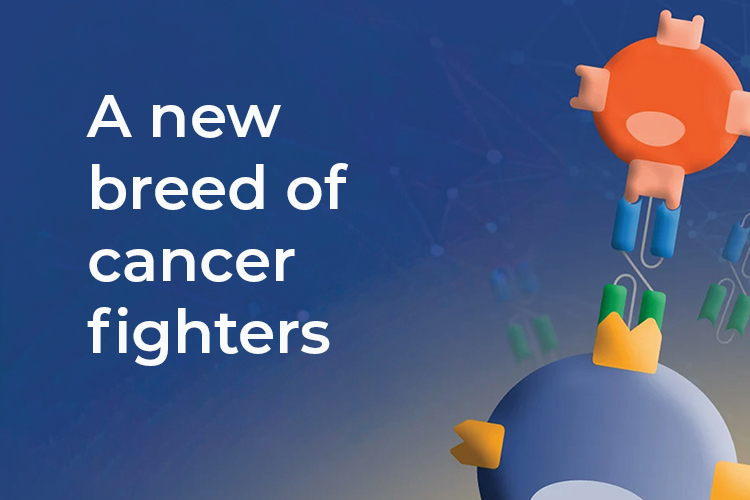
A new breed of cancer fighters
Dr Andrew Robson unpacks how smart science and smarter tech are changing the game as cancer fighters.
You can listen to this article below, or by using your favourite podcast player at pod.link/oncologybuddies
The body’s inherent ability to recognise and destroy cancer cells is a fascinating topic albeit exceptionally complicated. We have touched on this before where we discussed the unique ways animals have evolved to be resistant and, in some cases, even immune to cancer.
Yet, in both humans and animals, cancer often finds ways to fight back and hide in plain sight. Modern medicine is learning how to guide the immune system back to the fight, and one exciting tool leading this charge is called a bispecific T-cell engager (BiTE).
Training the body’s soldiers
Think of T cells as the immune system’s guard dogs. They’re trained to attack anything that looks suspicious, however, cancer cells are skilled at disguising themselves.
A BiTE acts like a bridge that connects a T cell directly to a cancer cell. One end of the BiTE attaches to a protein on the cancer cell while the other end attaches onto the T cell. Once connected, the T cell can’t ignore the target cell and releases toxic enzymes that destroy the cancer cell.
The first approved BiTE, blinatumomab, is already helping people suffering from lymphoblastic leukaemia, a form of blood cancer, and is an immunotherapy.
In veterinary oncology, similar immune-guided approaches are being explored for cancer treatments in companion animals. This gives us valuable clues about what works and what doesn’t, across species.
When guard dogs overreact
Because BiTEs effectively sensitise the immune system, some patients experience an over-reaction known as cytokine release syndrome (CRS) which they experience as a sudden wave of inflammation.
Doctors mitigate this by starting with reasonably low doses and making use of anti-inflammatory medicines. Researchers are also designing smarter BiTEs that only activate near tumour tissue, reducing collateral damage.
AI joins the team
Another ally in this story is artificial intelligence (AI). AI programmes can scan enormous genetic and imaging databases to find cancer specific flags that BiTEs can target. They can also help predict who might be at higher risk for side effects and match patients, human or animal, to the most suitable therapy or clinical trial.
In both veterinary and human medicine, AI is becoming the quiet expert in the background, turning mountains of biological data into insights that has the potential to improve safety and speed up discovery, provided it is used correctly and responsibly.
A shared future
What makes this partnership between BiTEs and AI so inspiring is its universality. Cancer biology isn’t limited by species, what we learn in one can guide treatment in another. Whether in people or in pets, these technologies are helping medicine do what it does best, give the body the tools to heal itself, more precisely and more safely than ever before.
MEET THE EXPERT

Dr Andrew Robson, a veterinarian based in Mpumalanga, holds a Master of Science Degree and has a special interest in companion animal health and well-being. Passionate about improving pet health and fostering the human-animal bond, he is also a proud dog dad.
Header image by Freepik
Visit the NEW Big C Survivor's Guide!!
