
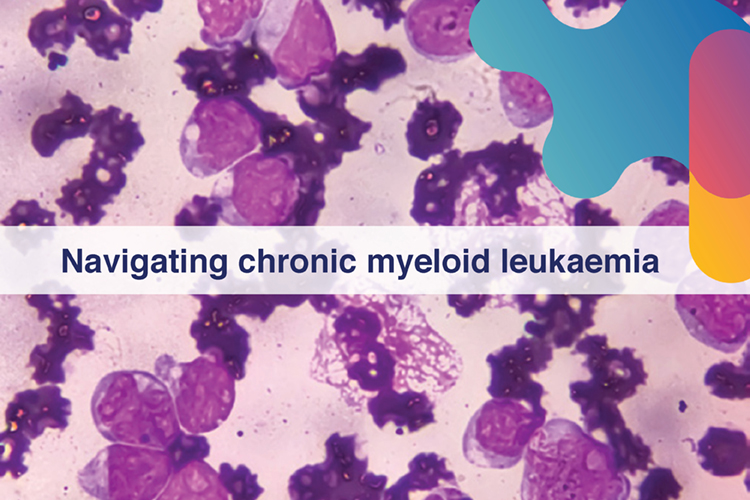
Navigating chronic myeloid leukaemia
This guide provides simple, practical information to help you navigate chronic myeloid leukaemia.
Where do blood cancers originate?
Blood cancer is a type of cancer that affects the blood cells and arises in the bone marrow, lymphatic system, or blood.1
Leukaemia, lymphoma, and myeloma are some of the most common types of blood cancers.1

What is chronic myeloid leukaemia (CML)?
Chronic myeloid leukaemia
Chronic – CML is a chronic, slow-growing type of leukaemia that develops and progresses over a long period of time.3,4
Myeloid – In CML, the myeloid cell line in the bone marrow grows and divides abnormally.4
Leukaemia – Leukaemia is a type of blood cancer that affects the blood and bone marrow, characterised by the uncontrolled production of abnormal white blood cells called granulocytes.3,4
There are three phases of CML3
- Chronic phase (by far the most common)
- Accelerated phase
- Blast phase (also called blast crisis)
What is Ph+ CML?
Ninety-five percent of CML cases are classified as Ph+ CML.5,6
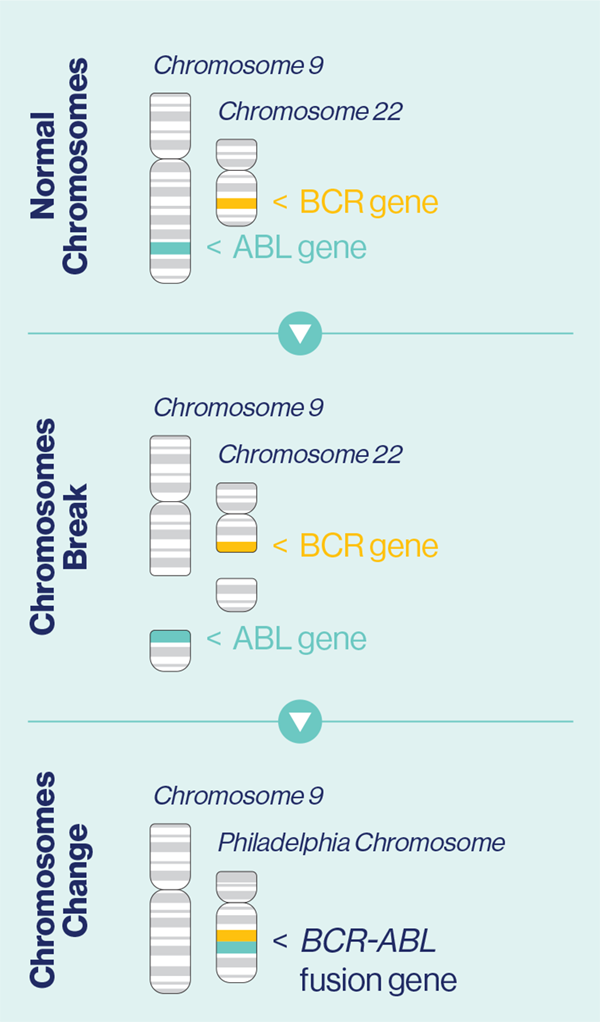
CML is caused by a genetic mutation called the Philadelphia (Ph) chromosome – a rearrangement in the genetic material between chromosomes 9 and 22.2,3
The region where chromosome 9 joins chromosome 22 creates a new gene, called BCR-ABL.3
How is CML diagnosed?
Blood tests, molecular testing, and chromosome analysis are used for diagnosis.10
- In the early stage of CML, most people feel fine, and the condition is usually picked up by a routine full blood count showing too many white blood cells.6
- The diagnostic marker is the presence of the Philadelphia chromosome (Ph+).7
- A polymerase chain reaction (PCR) test will confirm the level of CML that is detectable in the body.8 It is used as a disease monitoring tool which is usually performed every three months to begin with.6,8,9
Imaging studies, such as an ultrasound of the abdomen, may confirm the presence of liver and spleen enlargement, especially at diagnosis.2,3,8
- Complete blood count (CBC)10
- Bone marrow aspiration and biopsy8
- Cytogenetic analysis8
- Fluorescent in situ hybridization (FISH)8
- Polymerase chain reaction (PCR)8
What are the symptoms of CML?
Symptoms can be similar to those caused by other illnesses and tend to be mild at first and get worse slowly.11
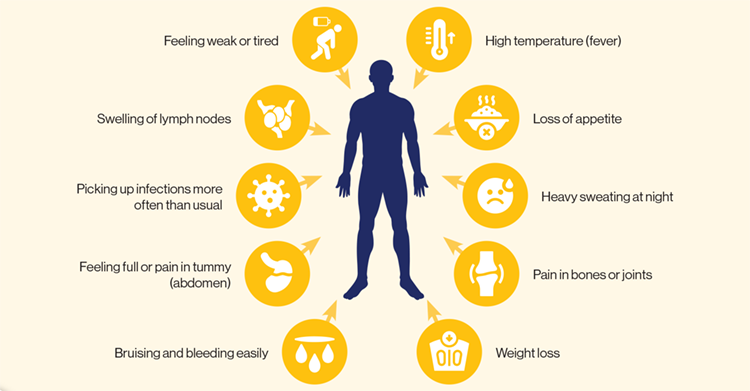
They can include: 11
- Feeling weak or tired
- Swelling of lymph nodes
- High temperature (fever)
- Picking up infections more often than usual
- Feeling full or pain in tummy (abdomen)
- Bruising and bleeding easily
- Loss of appetite
- Heavy sweating at night
- Pain in bones or joints
- Weight loss
What is the treatment for CML?
Every CML patient requires a multi-disciplinary individualised treatment approach comprising both psychosocial support and medical treatment. 6,12
Treatment aims to control CML long-term, achieve remission, and prevent progression to advanced phases.2 There are several kinds of treatment for CML:3
- Targeted therapy medicines, the most common treatment for CML, block the abnormal tyrosine kinase protein from the Philadelphia chromosome and have transformed its treatment and prognosis.3,10
- Chemotherapy, which uses cytotoxic agents to kill or slow leukaemia cells, is rarely used in CML and mainly given in advanced phases.2,3
- Supportive care controls symptoms of CML, like blood transfusion for anaemia (only if needed).3
- Stem cell transplantation, rarely used in CML, may be offered in advanced phases when targeted therapy or chemotherapy no longer work.2,3
The treatment team will explain the treatments, their benefits, and possible side effects.3
What are the treatment milestones in CML?
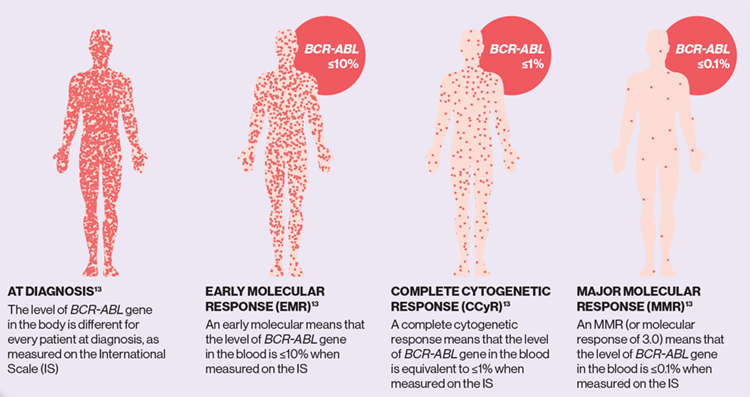
There are three types of treatment responses when judging the effectiveness of CML treatment.13
Molecular response: A molecular response is a measurement of how much of the gene BCR-ABL is detected in the blood or bone marrow.
Cytogenetic response: A cytogenetic response is a measurement of the number of cells in bone marrow that have the Philadelphia chromosome.
Haematologic response: A haematologic response is a measurement of abnormal cells the blood that have returned to normal.
AT DIAGNOSIS13
The level of BCR-ABL gene in the body is different for every patient at diagnosis, as measured on the International Scale (IS).
EARLY MOLECULAR RESPONSE (EMR)13
An early molecular means that the level of BCR-ABL gene in the blood is ≤10% when measured on the IS.
COMPLETE CYTOGENETIC RESPONSE (CCyR)13
A complete cytogenetic response means that the level of BCR-ABL gene in the blood is equivalent to ≤1% when measured on the IS.
MAJOR MOLECULAR RESPONSE (MMR)13
An MMR (or molecular response of 3.0) means that the level of BCR-ABL gene in the blood is ≤0.1% when measured on the IS.
What factors may affect disease response to CML treatment?
Compliance
Poor adherence is a significant contributor to treatment failure and loss of response to therapy.6
Drug-drug interactions
Drug interactions between targeted therapies and other medicines can make treatment less effective and increase side effects in CML patients.14
Dietary interactions
Effective CML management requires dietary considerations to maximise treatment outcomes.16 Certain foods, like grapefruit and high-fat meals, potentially altering drug absorption and levels, increasing side effects or reducing efficacy.15,16
Drug resistance
The development of resistance to the treatments can occur, which may require a change in therapy.4,10,17
References:
- Blood Cancer UK. About blood cancer. Available at:https://bloodcancer.org.uk/understanding-blood-cancer/about-blood-cancer/what-is-blood-cancer/. Accessed 20 September 2025.
- Cancer Council. Understanding Chronic Leukaemia – A guide for people with cancer, their families and friends. Available at: https://www.cancercouncil.com.au/wp-content/uploads/2024/07/Understanding-Chronic-Leukaemia-2024.pdf.Accessed 20 September 2025.
- Leukaemia Foundation. Chronic Myeloid Leukaemia (CML): A guide for people with CML and their support people. Available at: https://www.leukaemia.org.au/blood-cancer/types-of-blood-cancer/leukaemia/chronic-myeloid-leukaemia/. Accessed 20 September 2025.
- American Cancer Society. About Chronic Myeloid Leukemia (CML). Available at: https://www.cancer.org/cancer/types/chronic-myeloid-leukemia/about/what-is-cml.html. Accessed 20 September 2025.
- Kang ZJ, Liu YF, Xu LZ, et al. The Philadelphia chromosome in leukemogenesis. Chin J Cancer 2016; 35:48. doi:10.1186/s40880-016-0108-0.
- Eden RE, Coviello JM. Chronic Myelogenous Leukemia. [Updated 16 January 2023]. In: StatPearls [Internet]. Available at: https://www.ncbi.nlm.nih.gov/books/NBK5. Accessed 21 September 2025.
- Haider MZ, Anwer F. Genetics, Philadelphia Chromosome. [Updated 17 July 2023]. In: StatPearls [Internet]. Available at https://www.ncbi.nlm.nih.gov/books/NBK560689/. Accessed 21 September 2025.
- American Cancer Society. Chronic Myeloid Leukemia (CML) Early Detection, Diagnosis, and Staging. Available at: https://www.cancer.org/cancer/types/chronic-myeloid-leukemia/detection-diagnosis-staging/how-diagnosed.html. Accessed 22 September 2025.
- Cancer Research UK. Monitoring your response to chronic myeloid leukaemia (CML) treatment. Available at: https://www.cancerresearchuk.org/about-cancer/chronic-myeloid-leukaemia-cml/treatment/monitoring. Accessed 22 September 2025.
- Emadi A, Law JY. Chronic Myeloid Leukemia (CML). MSD Manual – Consumer Version. Available at: https://www.msdmanuals.com/home/blood-disorders/leukemias/chronic-myeloid-leukemia-cml. Accessed 2 March 2025.
- Cancer Research UK. Symptoms of chronic myeloid leukaemia (CML). Available at: https://www.cancerresearchuk.org/about-cancer/chronic-myeloid-leukaemia-cml/symptoms. Accessed 22 September 2025.
- Efficace F, Breccia M, Cottone F, et al. Psychological well-being and social support in chronic myeloid leukemia patients receiving lifelong targeted therapies. Support Care Cancer 2016; 24:4887–4894.https://doi.org/10.1007/s00520-016-3344-6.
- Treatment Milestones in Chronic Myeloid Leukemia (CML). Available at: https://www.healthline.com/health/cml/cml-milestones#overview. Accessed 22 September 2025.
- Saydam G, Ali R, Demir AM, et al. The Effect of Comorbidities on the Choice of Tyrosine Kinase Inhibitors in Patients with Chronic Myeloid Leukemia. Int J Hematol Oncol 2022; 11(1):IJH38. DOI: 10.2217/ijh-2021-0010.
- The National CML Society. Understanding CML. Available at: https://www.nationalcmlsociety.org/drug-food-interactions. Accessed 23 September 2025.
- Sheba Medical Center. 5 key lifestyle tips for CML patients. Available at: https://www.shebaonline.org/5-key-lifestyle-tips-for-cml-patients/. Accessed 23 September 2025.
- Jabbour E, Parikh SA, Kantarjian H, et al. Chronic myeloid leukemia–mechanisms of resistance and treatment. Hematol Oncol Clin North Am 2011; 25(5):981-995.

Novartis South Africa (Pty) Ltd, Magwa Crescent West, Waterfall City, Jukskei View, 2090. Co. Reg. No. 1946/020671/07. Tel. No. +27 (0) 11 347 6600.
To report an adverse event, email: [email protected] or report it directly through our website: www.novartis.com/report. Alternatively, call 0861 929 929. To report product quality complaints, email: [email protected]. Alternatively, call 0861 929 929.
Content ID: FA-11516368. Approval date: 22 October 2025. Expiry Date: 22 October 2027.