
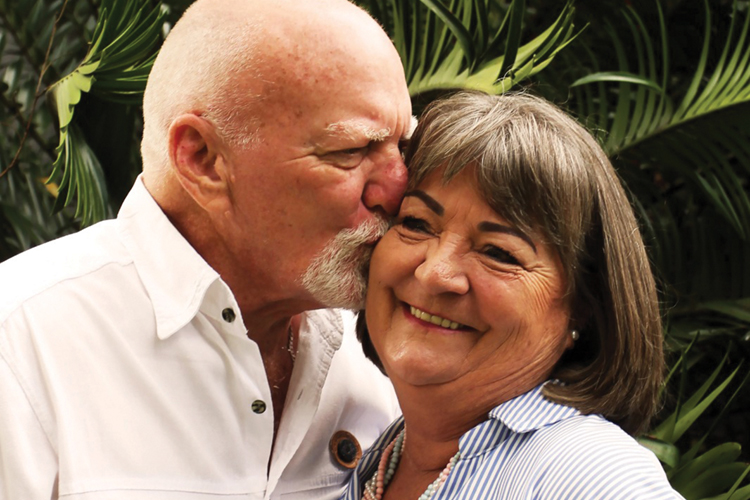
Eric Vorster – I felt like a failure
In the hope of encouraging couples to speak openly, Eric Vorster and his wife, Thersia, share how they, as a couple, overcame erectile dysfunction resulting from prostate cancer treatment.
Short on time? Listen to the audio version of this article here, or by using your favourite podcast player
Eric Vorster (68) lives in Heidelberg, Gauteng with his wife, Thersia. They have three children and seven grandchildren.
Eric was diagnosed with early-stage prostate cancer in 2016. He had no symptoms but was encouraged by his GP to include prostate cancer screening as part of his annual check-up. The screening was a prostate-specific antigen (PSA) blood test. His PSA level was slightly elevated, so he was prescribed medication to treat prostatitis.
Due to the PSA level not decreasing, the GP ruled out prostatitis and Eric underwent a digital rectal exam. The GP was concerned about the size of the prostate so referred him for a sonar. He then underwent two biopsies where nothing was found.
However, after a prostate MRI and a third biopsy, early-stage prostate cancer was diagnosed.
Brachytherapy
The treatment proposed by the urologist was brachytherapy. This is internal radiation therapy which involves placing radioactive material (seeds) directly inside or next to a tumour.
Eric consented and had 44 seeds inserted during a day procedure. After the procedure, he was tender and sore for two to three days.
Erectile dysfunction
Roughly three or four months after having brachytherapy Eric noticed he was experiencing erectile dysfunction. He felt immense shame and didn’t tell his wife; hence he started to avoid intimacy.
“To call a spade a spade, a man’s package is his pride, and I felt shame that it wasn’t working properly plus intercourse is part and parcel of marriage. I felt like a failure. In my head, I thought my wife had noticed and I was embarrassed,” he says.
Thersia recalls, “I noticed how his affection towards me was decreasing and automatically thought something was wrong with me. At the time, I was still working and had a busy schedule, so I thought that was bothering him. I didn’t know how to approach the subject,” she says. “However, when I retired and had more time to spend with him, it still continued so then I knew it wasn’t my workload.”
Communication
For a long time, Eric and Thersia never spoke about it until one day Eric confessed that he thinks there is a problem and he may have erectile dysfunction. When hearing this, Thersia was relieved as it meant the issue wasn’t her or anything she had done or not done.
They made an appointment with the urologist to discuss the way forward. “The urologist is a good guy, but he doesn’t talk much and we were told there isn’t much he can do. He then suggested testosterone gel or injections. When I asked my oncologist, she said that isn’t an option as testosterone helps prostate cancer to grow,” Eric explains.
Thersia adds, “It would have been nice if the urologist had given a leaflet or a resource on erectile dysfunction that Eric could read through.”
When asked if the urologist explained that erectile dysfunction may be a side effect of brachytherapy before the procedure, Eric responds, “No, he explained how the procedure would work but nothing else.”
Navigating the way forward
Thersia says, “We had no one we could talk to, to find out if they are having the same issue. I think it would have helped tremendously.”
When asked whether he would have attended a support group for prostate cancer survivors to discuss erectile dysfunction if he had known about one at the time, Eric responds, “Back then which was about10 years ago, no, I wouldn’t have. But today, yes I would.”
He adds that even if he knew that erectile dysfunction was a side effect of brachytherapy, he would still have had the treatment as it’s non-invasive. Though, he may have been more prepared for erectile dysfunction.
Getting past the limitations
Thankfully, throughout the years, intimacy has gotten better for Eric and Thersia. “There are still limitations, but we work around those. It was about a month or two ago that we really started to talk about it. Yes, I was uncomfortable, but it was good to hear what my wife needs and wants. This put me at ease and was a big gamechanger as I could meet those needs and wants,” Eric explains.
Thersia adds, “Women are different as we aren’t into sex the whole time. To me the closeness of just being held and kissed; that connection is the most important. The essential thing is for us to make each other feel wanted.”
Both Eric and Thersia urge young men to go for their annual prostate checks from age 40 to 45. “They need to know that if they go for these checks, prostate cancer will be picked up early and they will have a healthy sex life until older age without hardship ahead. Erectile dysfunction is a hardship for many men,” Thersia says.
MEET OUR EDITOR

Laurelle Williams is the editor at Word for Word Media. She graduated from AFDA with a Bachelor of Arts Honours Degree in Live Performance. She has a love for storytelling and sharing emotions through the power of words. Write to [email protected]

Header image supplied