
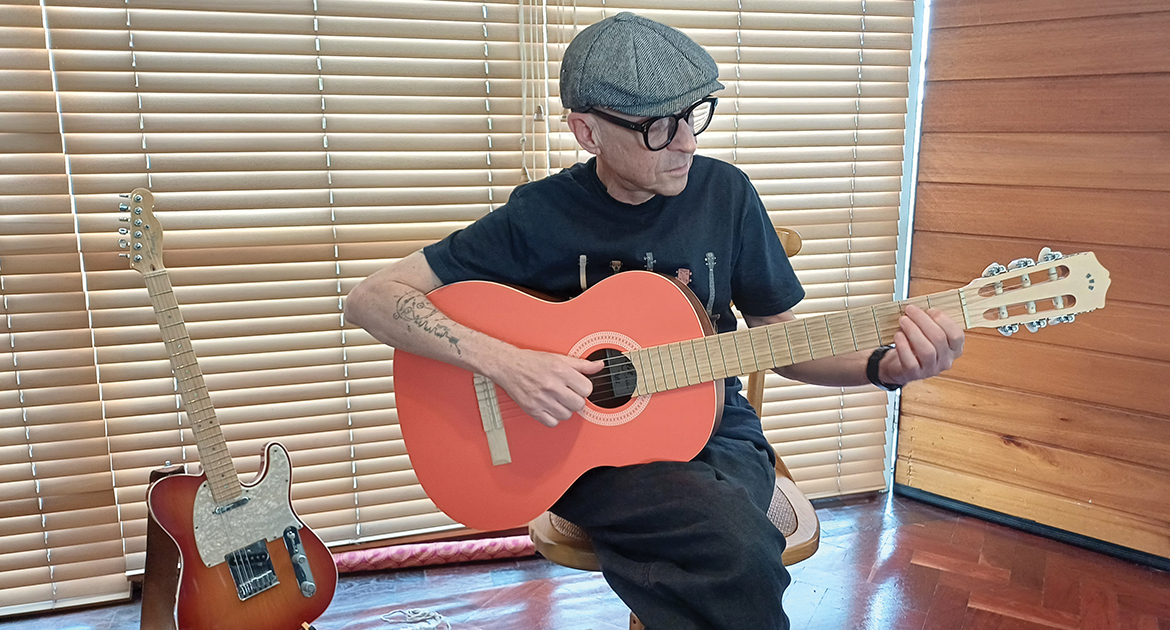
Graeme Sacks – Composing a new chapter
Graeme Sacks shares how music has been his healing companion through years of living with Hodgkin lymphoma.
Graeme Sacks (57) lives in Johannesburg, Gauteng with his wife.
Music is a big part of Graeme’s life; he had a successful career as a professional musician until he was diagnosed with Hodgkin lymphoma (HL) in 2012. However, the song didn’t end there. Throughout the 13 years of relapses and new treatment regimens, music was a constant which instilled calm, gave him hope, and helped his healing process. This prompted him to return to university, in 2017, and complete a Master’s in Music Therapy. He now uses music to help others.
Hodgkin lymphoma diagnosis
For over a year, Graeme consulted various GPs as he had flu-like symptoms, fatigue, and difficulty breathing. In 2012, he was rushed to casualty as he was unable to breathe properly and was diagnosed with Hodgkin lymphoma (HL).
“I was X-rayed for the first time and the growth showed up on the scan. The tumour was pushing against my superior vena cava (known as SVC syndrome) which prevented blood from being drained from my brain; my head had swelled up constricting my breathing,” Graeme explains.
In spite of the diagnosis, Graeme was partly relieved to have found out why he had been feeling sick for so long. “I had put my exhaustion and illness down to burnout and overwork. It was good to know that it wasn’t my fault. But I was also terrified. You don’t know anything about cancer until it affects you. I had heard the terms chemotherapy and radiation before, but I had no understanding of what they actually entailed.”
13 years of ongoing treatment and relapses
Graeme first received the standard first-line treatment for HL which is a combination chemotherapy protocol. The side effects were nausea, fatigue, and chemo brain.
Within six months, Graeme relapsed and had to start a new treatment plan. For the past 13 years, due to the advanced stage disease, he has had ongoing relapses and undergone various treatments: broad-spectrum radiation followed by another combination chemotherapy protocol for three months. Unfortunately, he had to stop this protocol due to severe side effects.
He then had a small tumour surgically removed, followed by targeted radiation. This remission was short-lived too.
In 2016, Graeme had an autologous (using own cells) stem cell transplant which was unsuccessful. He was then prescribed an immune checkpoint inhibitor (ICI), a type of immunotherapy, for two years which put him in remission for six years.
In late 2024, Graeme relapsed again and was put on an antibody-drug conjugate, a targeted therapy, for a year. A partial response was seen at first but later declined.
Psychosocial support and well-being
Graeme admits that the ongoing relapses have been extremely tough on his mental health. “I have an amazing therapist and couldn’t get through any of this without her.
I feel it’s so important to have someone to talk to who isn’t a friend or family. Therapy has been life-changing and has taught me how to be a better human and how to function better in the world. It was also one of the reasons I decided to study further and become a therapist myself,” Graeme says.
“My wife has played a huge role too. We’ve developed a relationship where we communicate safely on any topic, no matter how difficult or uncomfortable. Meditation has helped and so has mild exercise. I’m not a sporty person and don’t do gym but I enjoy long walks. I’ve tried to get over the guilt of not exercising or meditating when I’m not up to it or too busy.”
He adds, “Studying music therapy has also taught me coping skills that I use both with my clients and for my own benefit. With that said, there are times when I feel despair and like giving up.
I really abhor the hero narrative associated with cancer patients and survivors. I’m human, I’m vulnerable and sometimes it just becomes too much to deal with. We don’t have to feel strong all the time.”
Current treatment plan
Graeme is currently on another immunotherapy ICI, and has recently completed 18 cycles of targeted radiation. He is waiting to undergo an allogeneic (using cells from a donor) stem cell transplant. This is dependent on finding a suitable donor (his family member wasn’t a full match) and medical aid authorisation. His hope is that it will take place in the next few months.
Unnecessary, added stress
Sadly, Graeme says that in some ways his medical scheme has caused him more stress and anxiety than the cancer. “They have covered a lot, but not without endless fights and hours on hold on the phone. I pay nearly R20 000 a month for medical aid and at the moment I’m still paying R4000 per treatment and many other co-payments. There are amazing new treatments available today, but the pharmaceutical companies charge exorbitant fees for them. Medical schemes make enormous profits and have no real concern for their clients’ well-being.”
How music has helped
“Music has been a crucial part of my recovery and mental health. Listening to music in hospital helped me to connect with my childhood and family memories.
I went for singing lessons with a friend during recovery and discovered the absolute joy of using my voice. It was calming and empowering (and encourages healthy breathing habits),” Graeme explains.
“I often improvise freely on guitar or vocals without any goals or judgement. The music sometimes comes out angry and dissonant, sometimes sad and mournful, and other times beautiful and joyful. It’s all a reflection of my state and it often gives me insight into myself. I also write songs. Both my cancer and my music therapy studies have deepened my songwriting and my playing.”

This article is sponsored by Takeda Oncology in the interest of education, awareness, and support. The content and opinions expressed are entirely the patient’s own work and not influenced by Takeda Oncology in any way.

Header image by Freepik
C-ANPROM/ZA/ADCE/0064 JANUARY 2026