
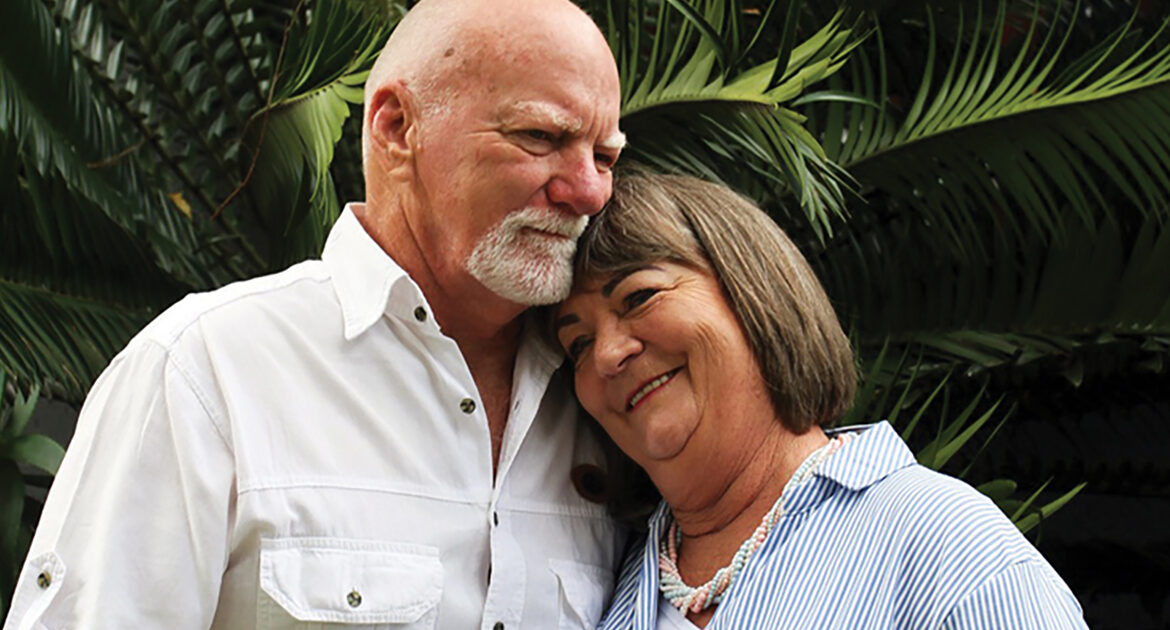
Eric and Thersia Vorster – United in the fight
Eric and Thersia Vorster share how they were forced to upgrade their medical aid to get Eric treatment for Stage 4 kidney cancer.
Short on time? Listen to the audio version of this article here, or by using your favourite podcast player
Eric Vorster (67) lives in Heidelberg, Gauteng with his wife, Thersia. They have three children and seven grandchildren.
Stage 1 kidney cancer
In early 2016, Eric was diagnosed with Stage 1 kidney cancer. He had no symptoms, but it was picked up during a sonar regarding his prostate. His prostate was deemed healthy though further check-ups were proposed. A CT scan confirmed the left kidney was riddled with cancer.
A nephrectomy (removal of the whole kidney) was done in March 2016. Before surgery, Eric had his last cigarette after smoking 20-a-day for 40 years.
No further treatment was needed with Eric routinely going for follow-ups.
Prostate cancer
A year later Eric was diagnosed with early-stage prostate cancer and underwent brachytherapy (44 pellets). This was successful; however, the major side effect is erectile dysfunction. Eric once again was diligent with his follow-ups.
Stage 4 kidney cancer
In late 2023, at a yearly follow-up, a scan showed three lesions on the right kidney. Eric was referred to a urologist who specialises in robotic surgery to remove the lesions. Eric’s medical aid wouldn’t cover the cost.
A family member, who is a nurse in the USA, told him about cryoablation (a procedure in which an extremely cold liquid is used to freeze and destroy abnormal tissue). After inquiring with his oncologist, he was referred to an interventional radiologist who was able to perform the procedure, in December 2024, on one of the lesions which was big enough; it was successful. Though, the other lesions were still there.
Further biopsies were done as lesions were picked up on his back, behind his ear, and a wart-like growth on his forehead. The results confirmed metastatic kidney cancer. The growth on his forehead was surgically removed and he underwent radiation for the lesions on his back and behind his ear.
Proposed treatment
Due to Eric only having one cancerous kidney, chemotherapy was ruled out as that remaining kidney wouldn’t handle that strain, which would mean lifelong dialysis.
The only other option, given by his oncologist after his case was discussed in a multi-disciplinary meeting, was to go on pazopanib, an oral targeted anti-cancer drug.
“I was told this drug will stop the cancer from spreading and growing but will never get rid of it,” Eric says.
In mid-2025, the oncologist prescribed the drug, but Eric’s medical scheme declined it. “My oncologist did everything she could, she wrote another motivation letter and it was declined again.
She referred the appeal to Campaigning for Cancer, however, the medical scheme still declined it. We were in her rooms when she told them to refer it to the Council of Medical Schemes (CMS),” Eric explains.
The medical scheme explained that the plan Eric was on, doesn’t cover this medication and if he wanted it covered he would have to upgrade his plan, which would be an additional +-R7000 a month.
“What frustrated us was that we had an amount of R360 000 available in our oncology benefit, but they said that was only for chemotherapy and radiation. The response from CMS was taking long and obviously we got scared so we were forced to upgrade. We are pensioners and now are paying almost R17 000 a month for the two of us.”
“A week later after upgrading, we got a response from CMS saying the medical scheme has to pay for the medication, however, they also gave them three months to appeal. I couldn’t wait that long before I start treatment with the cancer spreading as fast as it is,” Eric says.
Currently, the cost of his pazopanib (60 tablets) is R40 700 a month; the scheme is covering the full cost of this. Since September 2025, Eric takes two tablets (800mg/day) at the same time, every morning, on an empty stomach.
Eric plans to take the case to the Ombudsman.
Side effects
Last year, further lesions were found in Eric’s stomach; they were surgically removed.
Since being on pazopanib, he feels good and is hoping for a positive outcome when he has his CT scan in April.
The side effects are high blood pressure (he had high blood pressure before), fatigue, dizziness, pins and needles in his feet, and lack of strength.
Thersia adds that he also has mood swings. “Out of nowhere, he’ll get quiet and then I know I must be careful what I say or else he gets snappy. I think it’s underlying anger,” she says. “Luckily I’ve learnt to read him and work around it.”
Despite this, she adds that since the metastatic diagnosis, their communication has gotten better and as believers, they believe there is a purpose in all of this.

Photographer:Chrisna Bock