
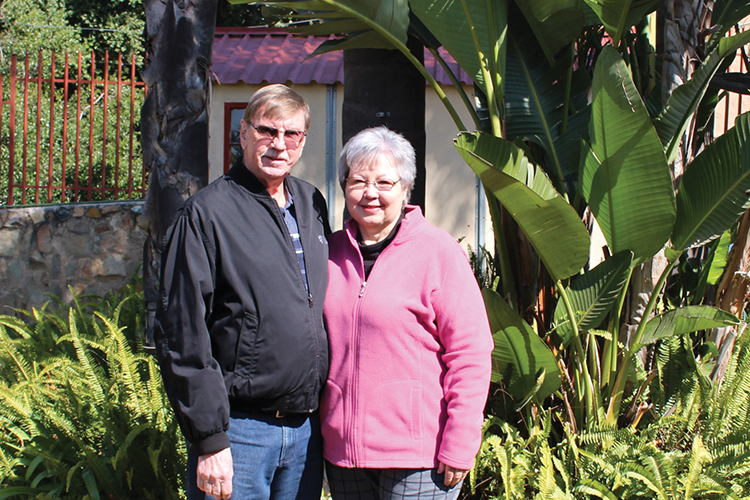
Bessie van Antwerp – Finally on target
After eight years of changing treatment regimens to manage Stage 4 lung cancer, Bessie van Antwerp happily reports a major tumour shrinkage thanks to the targeted drug, osimertinib.
You can listen to this article below, or by using your favourite podcast player at pod.link/oncologybuddies
Bessie van Antwerp (73) lives in Weltevreden Park, Gauteng with her husband, Frans. They have two children and two grandchildren.
When Bessie was diagnosed with lung cancer in 2015, her concern was that it was related to the breast cancer she had been treated for (lumpectomy and radiation) in 1988. The doctor confirmed that it wasn’t; it was a new primary cancer and the most common lung cancer: non-small cell lung cancer.
The reason she went to her GP was due to pain in her left arm. An X-ray led to a shoulder operation. After surgery, Bessie was gasping for air and more tests revealed that one of Bessie’s lung had collapsed and treatment was provided.
“A month later I again struggled to breathe. We went to my GP again; I had blood tests and I was to see a specialist physician immediately.”
A CT chest scan was done, and the specialist requested the previous scans from when Bessie’s lung collapsed. The new CT scan showed fluid on the lung; three litres were drained and some sent for pathology, which confirmed it was Stage 4 lung cancer.
Various treatments
Bessie consulted with an oncologist and further testing was done. Bessie was told if she didn’t have treatment, she would survive three months and if she had treatment, it would extend to 11 months. It was also explained that this cancer was common in women who never smoked.
The oncologist prescribed a targeted oral drug that Bessie took daily at the same time. Unfortunately, Bessie experienced terrible side effects: pimples all over her face. “Once that was under control, I was red all over, like I was burning from the inside and my skin was peeling off,” Bessie recalls.
The treatment was stopped for two weeks but Bessie’s children pleaded with her to take it again.
So, Bessie asked the oncologist if she could start on a lower dosage and gradually get to the correct dosage. This plan worked, and Bessie was on the drug for three and a half years, going for regular scans, with the cancer remaining stable.
62 chemotherapy infusions
In July 2019, the cancer progressed and the targeted drug was stopped and Bessie started a combination of chemotherapy. Within days, Bessie lost her hair, so her daughter helped shave her head and her son, who had long hair, shaved his head in support. “His gesture was so precious,” Bessie says.
In February 2020, the chemo regimen was changed as the previous one wasn’t effective anymore. By September that year, Bessie needed a chemo port as the nurses were struggling to find veins.
In June 2021, the regimen had to be changed again and again that September, which continued for nine months. All these changes were due the cancer progressing. In total, Bessie had 62 chemo infusions.
New targeted drug
In May 2022, Bessie was prescribed another oral targeted drug. This drug stabilised the cancer for just over a year, but then new nodules started to appear. The oncologist requested a biopsy to see if the cancer had specific EGFR mutations for the latest targeted drug, osimertinib.
In December 2023, Bessie’s medical aid approved the new treatment regimen of osimertinib. This oral tablet must also be taken daily at the same time every day. Bessie takes it at seven in the morning.
Within three months, there was only 25% of the tumour left and all the new nodules were gone. When hearing this news Bessie cried tears of joy as it was the best news she had heard for a long time.
Currently, she is still on osimertinib and goes for three-monthly CT chest scans and a yearly PET scan. In May this year, the disease was stable.
“I have side effects but I think they are from the years of all the treatment I’ve had. The main one is leg cramps which I take magnesium, sea salt, and oral electrolytes for.”
Family equals happiness
Bessie is so grateful to her family for their support. “My husband is incredible; he is my nurse. My children too. From the very beginning they asked me to not shut them out and reminded me that it isn’t complaining but rather sharing,”
she says tearfully. “I’ve surpassed the lifespan the doctor thought I would have and for that I’m forever thankful.”
She adds, “Happiness is my family and to see the progression of my grandson who is on the spectrum. Peace is to accept the things that I can’t change and move forward and to know God is in control and that He gives us that peace.”

This article is sponsored by AstraZeneca in the interest of education, awareness, and support. The content and opinions expressed are entirely the patient’s own work and not influenced by AstraZeneca in any way.
Header image supplied