
When resources fall short
Dr Memory Bvochora-Nsingo reveals the reality of moral distress in African healthcare, where a lack of resources can leave healthcare professionals facing difficult choices.
You can listen to this article below, or by using your favourite podcast player at pod.link/oncologybuddies
I arrived in Malawi this year on 6 July, Malawi’s Independence Day. Across the country, Malawians were commemorating the day, in 1964, when their nation gained independence from British colonial rule. There was something deeply symbolic about arriving on such a day. While Malawi celebrated more than six decades of national independence, I had arrived as an expert under the International Atomic Energy Agency (IAEA) programme to support and mentor a team taking another important step towards self-reliance: building the capacity to offer women with cervical cancer complete, potentially curative radiation treatment within their own country.
As in many countries across sub-Saharan Africa, cervical cancer remains the most common cancer among women in Malawi and a leading cause of cancer death, making access to effective curative treatment particularly urgent.
Malawi had recently commissioned and started high-dose rate (HDR) brachytherapy, an essential component of curative treatment for cervical cancer. Brachytherapy delivers a concentrated dose of radiation directly to the tumour and without it, treatment is incomplete. The excitement among the local team was tangible; after years of having no access, they could finally offer women a complete pathway towards cure.
But almost immediately, we encountered a painful dilemma.
Too many women to treat
A long-standing backlog had developed. Some women had completed external beam radiotherapy months earlier and had been watching the arrival of brachytherapy with hope and expectation. They had waited patiently for their opportunity.
But there was now another group: women currently undergoing radiotherapy. For cervical cancer, time matters. External beam radiotherapy and brachytherapy should ideally be completed within 50–56 days. Delaying these women to clear the historical backlog could compromise their chances of cure.
Who should be treated first?
I sat with one of the local doctors, Christine, as she studied the waiting list. I could see two emotions simultaneously: the enormous joy of finally having brachytherapy and the anguish of knowing that the service couldn’t immediately accommodate everyone who needed it.
We examined dates and calculated treatment intervals. We discussed whether treatment remained curative or had become palliative. We asked how we could honour women who had already waited so long without creating another generation of women whose treatment would also be delayed.
There was no perfect answer. This, for me, is the reality of moral distress in African healthcare: knowing what your patients need but not having enough resources to provide it for everyone. In a well-resourced setting, we ask, What is best for this patient? In a resource-limited setting, we are forced to ask, If I treat this patient, what happens to the next one?
Behind every name on that waiting list was a woman hoping for more time. I remember telling Christine, “You have started. You are moving forward.” We can’t always change what we lack today, but we can use what we have wisely and compassionately while continuing to build for tomorrow.
So, we worked
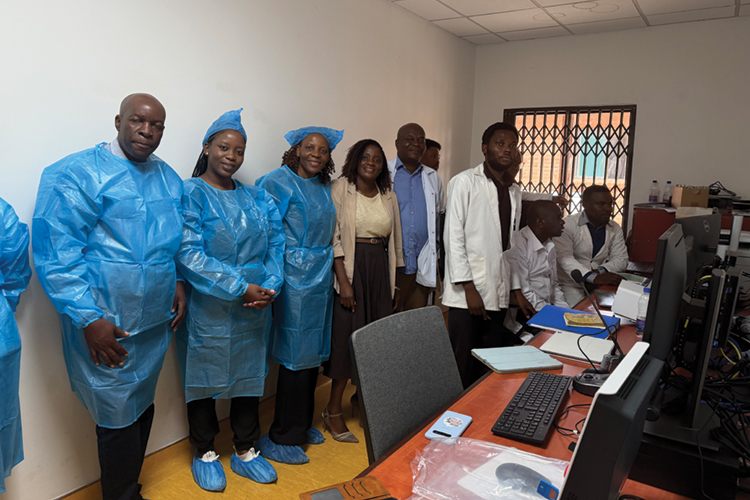
We reviewed patients, refined processes, taught, learnt from one another, and treated women. During that mission, the team successfully delivered CT-guided brachytherapy to 13 women in three days. The joy among the clinicians was extraordinary. These were professionals who had always possessed the knowledge, commitment, and compassion to care for their patients. They now had the tools to translate that commitment into potentially curative treatment.
My experience in Malawi reminded me of visits to other parts of Southern Africa where access to radiotherapy is absent. It also reminded me of Botswana, where I have witnessed what sustained access to radiotherapy and brachytherapy can achieve. I have seen women with cervical cancer return years after treatment, cancer-free, working, raising children, and living their lives.
As Malawi celebrated its independence that week, we too celebrated, not because every problem had been solved, but because something important had begun.
Yesterday we could not, Today we can
There was still a backlog, difficult decisions to make, and much work ahead. But perhaps compassion doesn’t require us to solve every problem before we allow ourselves to celebrate progress. It asks us to recognise suffering, to use wisely what is in our hands, and to keep moving forward.
Moral distress reminds us of what is still missing. Compassion moves us to act. And progress gives us reason to hope.
As Malawi celebrated its independence, I celebrated with the remarkable team at the National Cancer Centre, a team building its own capacity to offer women with cervical cancer a chance of cure at home.
Happy Independence, Malawi. And to the National Cancer Centre, Zikomo—thank you for allowing me to be part of your journey.
MEET THE EXPERT

Dr Memory Bvochora-Nsingo is a clinical oncologist with 20 years of experience in radiation oncology and chemotherapy, specialising in the treatment of cancers of the cervix, breast, prostate, head and neck, and many others. She has worked for 16 years in Botswana, achieving significant success in both curative and palliative care, including end-of-life care. Currently, she works at Gaborone Private Hospital and is involved in government work as well.

Header image by Magnific