

When Christmas hurts
Bonita Suckling (mom to Jed) talks about grieving deceased loved ones on special days, like Christmas.
You can listen to this article below, or by using your favourite podcast player at pod.link/oncologybuddies
For nearly a decade, I didn’t do Christmas. No fairy lights on the balcony. No laughter spilling from the kitchen. Phone off. Silence. Dinner was peanut butter on toast. Birthdays came and went like ordinary days. Holidays had no colour, no music, no reason. Grief moved in and unpacked its suitcase.
I think, in some strange way, I was honouring my son, Jed, by being sad. I wanted the world to see how much I missed him, how deep the hole was. Maybe I didn’t have a choice. Maybe it was just the only way I knew how to love him when he wasn’t here.
People would say things like, “If it were my child, I’d never survive.” And I’d nod politely, but inside, those words landed hard. Because I was surviving… barely, some days, but still here.
Then came the guilt
Guilt was felt for breathing, for eating, for doing small, normal things like brushing my teeth or laughing at something silly. After hearing it so many times, I started wondering, wait… are they saying that if it were them, they’d have killed themselves? And if that’s what they meant, then what did that make me, a bad mother for not dying too?
It’s absurd, but grief makes your brain twist everything. I remember thinking, so now I feel guilty for not being dead. Honestly, the logic was wild. But that’s grief for you, it hands you a script that no sane person would ever write.
Surviving is not a betrayal
Eventually, I realised that surviving wasn’t a betrayal to Jed…it was the bravest thing I could do.
And if I can offer one piece of advice, it’s this: be careful with your words around grief. The old clichés and platitudes might sound comforting, but they can land like stones. I’ve heard them all. My personal favourite? “God only chooses the most beautiful flowers for His garden.” I know people mean well, but honestly, my first thought is always, thank goodness you’ve got weeds.
When Jed died, everything stopped.
I remember the quiet being so loud it almost hummed. People still lived around me, and it felt rude, honestly. They had braais and birthdays and arguments about traffic and potholes, while I was frozen in a world that no longer fit.
For years, I thought happiness and grief couldn’t share the same space. I thought smiling meant forgetting and forgetting meant betrayal. So, I didn’t smile much. But grief is a strange teacher. It sits beside you, patient as anything, until you finally look up and realise the world is still happening.
Welcome back green and red tinsel
In December 2022, I decided to put up a Christmas tree again. That same year, I’d finished my postgraduate studies in paediatric palliative care, the best kind of therapy I never knew I needed. I sat in classrooms (and on Zoom calls) surrounded by the most incredible therapists, my classmates, people who understood pain in a way that didn’t need words. They gave me language for what I’d been living in for years.
I began to see that my grief wasn’t disloyalty or madness. It was complicated grief, the kind that wraps itself around you so tightly, you forget you’re allowed to move. That course cracked something open in me. The year 2022 I felt free from the heaviness of grief. It made me realise I wasn’t trapped forever.
So that December, I put up the tree. And it wasn’t just any tree, it was massive (you had to walk sideways to get past it). It pretty much took over my entire tiny lounge, dripping in cheap tinsel, glitter, and the most ridiculous twinkling lights you’ve ever seen. It was like Christmas had exploded and left the evidence right there in my tiny nest. Totally over the top.
But after 10 years, I figured I had a decade of Christmases to catch up on. It was both hilarious and healing.
Grief changes shape
The pain didn’t stop, but something loosened inside me. It wasn’t joy instead of sadness, it was both, all tangled.
That’s the thing nobody tells you about grief: it doesn’t end; it just changes shape. It becomes part of your wiring. You carry it into new moments, new laughter, new people. It’s there when you dance. It’s there when you cry. It’s there when you love again.
These days, I do Christmas. The tree goes up. There’s laughter spilling out of the kitchen again. Music that is too loud, too merry and perhaps too Christmas…Always a special ornament for Jed on my over-the-top tree.
I still miss him with everything in me. But now I join dinner, wrap gifts, laugh at bad jokes, and wear the hat from the cracker (I still get the worst cracker gift, I gave them 10 years to get that right). I finally get it: grief and happiness can live side by side. They don’t cancel each other out.
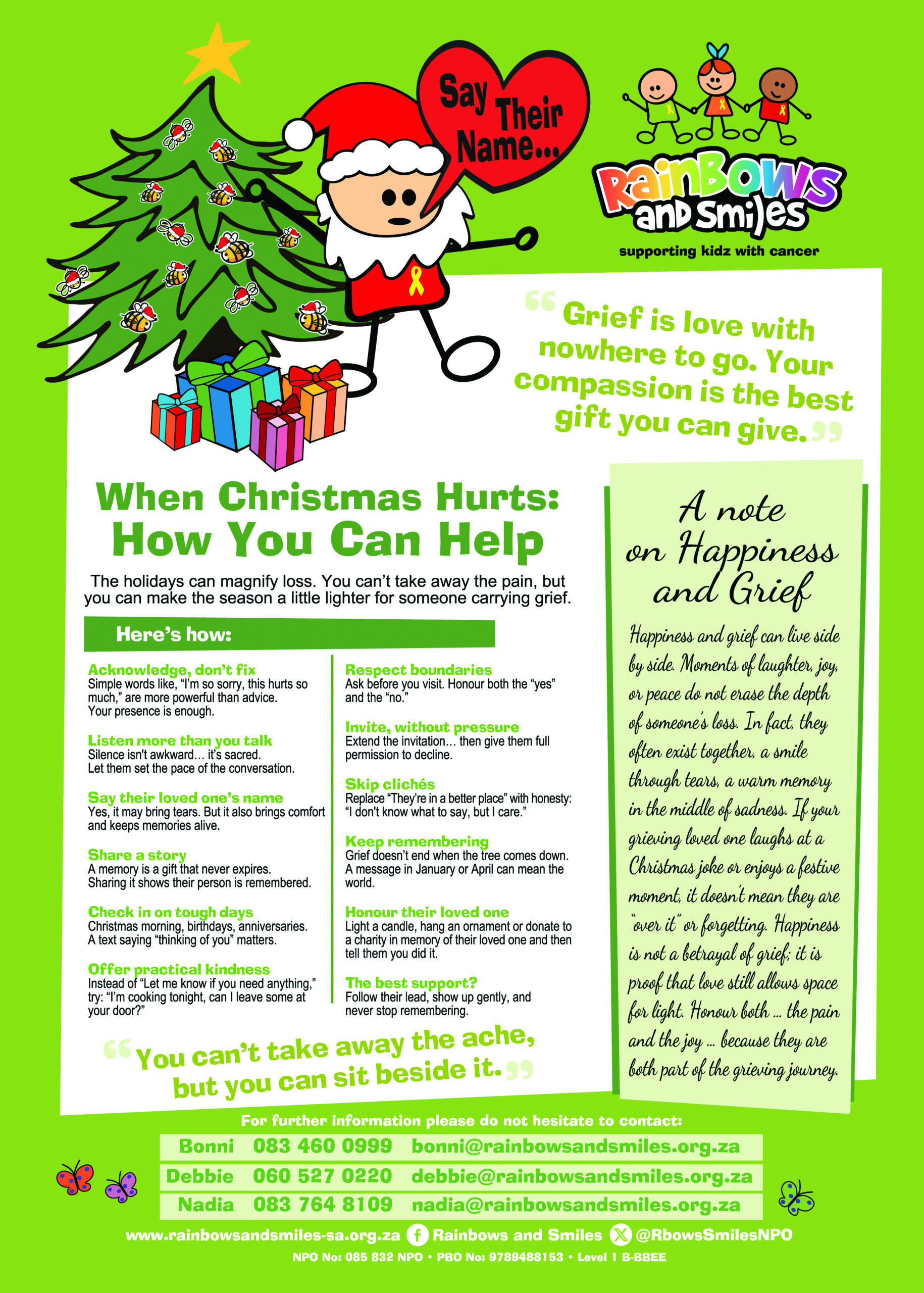
If you’re reading this and you’re grieving, please know this…you’re not broken for wanting to smile. You’re not betraying anyone for finding joy. You’re allowed to laugh while your heart aches. You’re allowed to decorate the tree and still cry when you hang the star.
Happiness doesn’t mean you’ve stopped loving them. It means you’re still alive, still carrying them forward in a world that doesn’t stop spinning.
So, this year, let the light back in. Wear the cracker hat. Read the cracker joke. Eat the food. Tell the stories. Say their name.
Invite grief to sit next to your joy at the table. Because love doesn’t disappear, it just learns to speak a new language.
MEET THE EXPERT

Bonni Suckling is the founder of Rainbows and Smiles Foundation. In 2022, she completed her Paediatric Post Grad Diploma, a testament to her dedication to improving paediatric healthcare. She has played a pivotal role in establishing paediatric palliative care support groups, offering solace and guidance to families. She is also a gym instructor and endurance athlete.
Header image by Freepik
Visit the NEW Big C Survivor's Guide!!
