
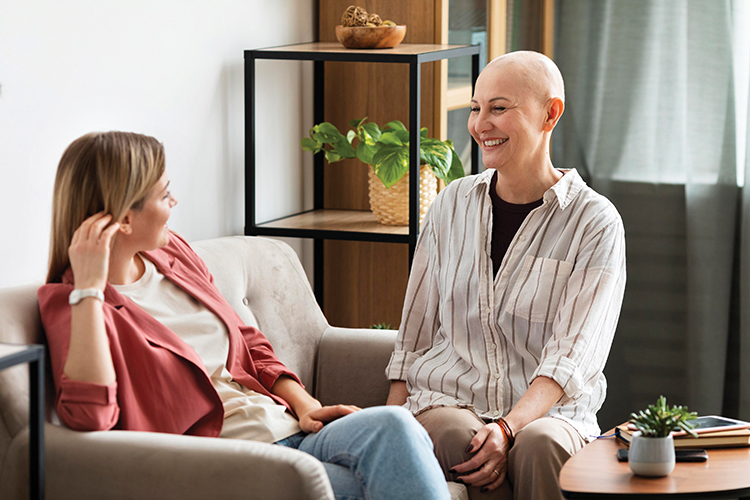
Helping a loved one with cancer during treatment
Caroline Rich defines the term caregiver and offers ways to support your loved one as best as you can.
You can listen to this article below, or by using your favourite podcast player at pod.link/oncologybuddies
Your loved one has been diagnosed with cancer, and you want to know what you can do to be supportive and provide the best care for them. This diagnosis can be overwhelming for the loved one, and so too for you as family and friends. The question is: what is the next step? What can I do to help make sure that this person feels supported and take the pressure off them? Also, how do I ensure thatI’m strong enough and emotionally available to take on this job? Awareness and knowledge are key to taking on this role.
Who are the caregivers?
Caregivers extend beyond the healthcare workers looking after the patient directly. Others can be considered a caregiver or supporter of the patient. Besides family members, close friends can also fulfil this role. Other considered caregivers can be spiritual advisors and members of the community in which the person lives. Essentially, anyone who is close to the patient and wants to get involved and help would be defined as a caregiver.
What is the role of the caregiver?
A caregiver of a cancer patient plays a critical role in supporting them through their journey. It’s advised to gain basic knowledge of the type of cancer and treatments that your loved one will be having. This information needs to come from credible sources (healthcare providers), and not an internet search.
This will help you be more knowledgeable regarding what they may need and what to expect going forward. It’s a good idea to identify someone to act as the liaison between all the supporters, the patient, and the healthcare providers. There are many aspects of the treatment that the patient will need to deal with, and each caregiver could play a role in different ways.
Emotional support
Encourage your loved one to be open with you and listen to their fears and concerns. It’s good to maintain a positive environment. You may find that it’s often difficult to know what to say. Ultimately, the simplest expressions are the most meaningful. Sometimes showing genuine concern and just listening is the best thing you can do. For example, you might say something as follows, “I don’t know what to say, but I want you to know I care and am thinking of you or I’m here for you when and if you need me.”
It’s highly recommended that as the caregiver, you encourage your loved one to see a counsellor who specialises in cancer care. These days, it can often take place online which is more convenient. Even if they don’t think they need this help, they may find that it really does help.
Practical support
It’s a good idea that your loved one jots down questions that they have and make notes during their appointments with the healthcare professionals. Often, they are so worried with what is going on, that they may not remember things being said to them and what questions to ask. Therefore, it’s a good idea for you to go with them to these appointments, so you can also make notes. This ensures that the communication of information amongst the caregivers is clear and understood. Always ask your loved one exactly what they need and what you can do to help to make things easier for them.
If you just say that you are there to help, it may be difficult for them to ask for something specific. Some tasks that a caregiver could take on is the day-to-day activities:
- Going to the shops and buying groceries
- Arranging transport
- Looking after children (if relevant)
- Keeping a schedule of appointments,
- Provide pre-cooked meals
Another aspect of how the caregiver can get involved is to assist with medical aid (if your loved one has a medical aid). This becomes a big part of what your loved one is going to go through, and often is the last thing that they want to have to deal with. Find an expert, like a broker, who can co-ordinate this, as it can get quite complicated and frustrating.
In instances that the medical aid won’t cover treatments and have declined after motivating, a fundraiser to ensure that the cost of treatment is covered can be set up. BackaBuddy is a good platform; this needs to be taken on by one person who would be good at co-ordinating such a campaign.
How to look after yourself
Caregiving can be emotionally and physically demanding. It’s important to seek help when needed and prioritise both your loved one and your own well-being. You will need to support each other as each person is different and may be dealing with things in their own way.
Keep the lines of communication open.
It’s suggested that the caregivers seek counselling for themselves as an individual and/or in a group setting. There is nothing wrong with asking for help, in fact it’s encouraged.
Ask your loved ones’ doctor to recommend an advocate/navigator who can assist you with understanding what you need to do so that you feel that you are being of help and not a hinderance. If you, as the caregiver, are going through a difficult time, you will not be able to support the patient optimally.
References
- There are many NGO’s that specialize in cancer. They can provide support to the patient and the caregivers. Individual patient advocates can also assist with answering questions and giving advice and can use their contacts to refer the patient and caregivers to other role players (e.g. counsellors) who can help.
- The Cancer Alliance is a collection of various NGOs and through them you can be pointed in the right direction to get help for yourself and the patient. They can be contacted through their Project Manager, Salomé Meyer, at 079 483 3175 or via email [email protected] You can also visit their website, canceralliance.org.za, for more information.
MEET THE EXPERT

Caroline Rich qualified as a radiographer in 1991 and worked in the pharmaceutical industry for 25 years. Her area of expertise became oncology/haematology, and she started working in the NGO space in this field 13 years ago. She now works as a patient advocate, guiding and empowering patients and families through their cancer journey.
Header image by Freepik
Visit the NEW Big C Survivor's Guide!!
