
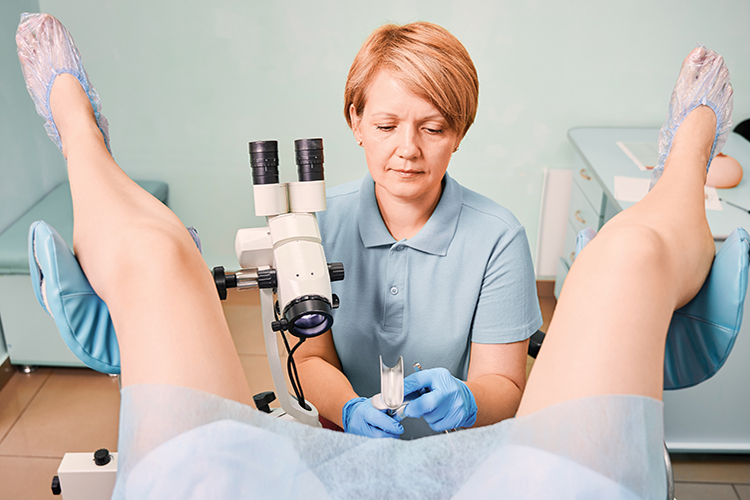
Cervical cancer screening
Kusha Kalideen highlights the importance of cervical cancer screening and discusses the two options: Pap smear and HPV PCR test.
You can listen to this article below, or by using your favourite podcast player at pod.link/oncologybuddies
Cervical cancer, the second most common cancer in South African females, is primarily caused by the human papillomavirus (HPV). HPV is a common viral infection that infects certain cells during skin-to-skin contact, often through sexual activity. There are several types of HPV, which can be classified into high-risk types (which are associated with the development of cervical cancer), and low-risk types (not typically associated with cancer).
While most HPV infections are cleared by our immune systems, there are instances where individuals can’t eliminate the virus. A persistent high-risk HPV infection causes infected cells to change and become abnormal over time, which might become cervical cancer.
Screening
Regular screening tests can identify women at the early stages of disease or who may be at an increased risk of cervical cancer. When cervical cancer is detected in the early stages of disease, it can be successfully treated.
There are two ways women can screen for cervical cancer: Pap smear or HPV polymerase chain reaction (PCR) test.
Pap smear
A Pap smear uses a liquid-based cytology (LBC) sample that is collected by a trained healthcare professional during a pelvic exam. In a Pap smear test, the cells of the cervix are examined to see if any of the cells are abnormal and may become cancerous, or if there are cancerous cells present.
Unfortunately, a traditional Pap smear can’t identify if you are at an increased risk for developing cervical cancer and therefore a Pap smear is repeated every two to three years.
HPV PCR test
The HPV PCR test looks for the presence of the virus, HPV, in cells of the cervix and can identify if you are at an increased risk for developing cervical cancer. The LBC sample can be used for HPV PCR testing; however, women can also collect their own sample for HPV PCR testing.
Some laboratories in SA allow women to collect their own vaginal sample for HPV testing with a self-sampling brush or self-sampling swab. These self-sampling kits can be collected at certain laboratory depots, with instructions as to how you can take your own sample. Once completed, the self-sampling kit can be dropped off at the depot and then sent to the laboratory for testing.
HPV PCR testing results
If the HPV PCR test is negative, you don’t need to test again for five years.
If the HPV PCR test is positive for a high-risk HPV type, a Pap smear is recommended. A positive test doesn’t mean you have cancer or that you will get cancer. It does mean you are at a high risk and require more testing.
Who should consider a HPV PCR self-test?
HPV self-testing is encouraged as a primary screening method for cervical cancer in women who are 25 years of age and older, and women who are sexually active.
Unfortunately, HPV self-testing is not recommended in the following cases:
- Under the age of 25
- If you’re pregnant
- If you have given birth less than six weeks ago
- During menstruation
- If you’re experiencing any unusual bleeding, pain, or discharge
- If you have had a total hysterectomy
- If you have a history of pre-cancerous or cancerous changes in the cervix
Takeaway message
Regular screening is important for detection of women at an increased risk for cervical cancer. Self-sampling for HPV testing increases access to testing and is a convenient option for screening. Self-sampling kits are available at certain laboratory depots countrywide. Please contact your local testing laboratory to locate your nearest depot that offers self-sampling kits.
References
- Botha, M. H., et al. “Cervical Cancer Screening Guidelines for South Africa.” African Journal of Obstetrics and Gynaecology 1.1 (2023): 27-31.
- Bray F, et al. Global cancer statistics 2022: GLOBOCAN estimates of incidence and mortality worldwide for 36 cancers in 185 countries. CA Cancer J Clin. (2024) May-Jun;74(3):229-263. doi: 10.3322/caac.21834. Epub 2024 Apr 4. PMID: 38572751.
- Martins TR, Levi JE. Molecular Screening for Cervical Cancer. Genes (Basel). 2025 Sep 2;16(9):1041. doi: 10.3390/genes16091041. PMID: 41009986; PMCID: PMC12469344.
- Wolf J, et al. Human papillomavirus infection: Epidemiology, biology, host interactions, cancer development, prevention, and therapeutics. Rev Med Virol. 2024 May;34(3):e2537. doi: 10.1002/rmv.2537. PMID: 38666757.
MEET THE EXPERT

Kusha Kalideen is a medical scientist specialising in molecular testing of solid tumours to aid in diagnosis, prognosis, and therapeutic options in cancer patients. She currently works at Lancet Laboratories.
Header image by Freepik
Visit the NEW Big C Survivor's Guide!!
